A Prayer You Can Play: Vedanta Desika's Knight's Tour
Thirty-two syllables on half a chessboard: read them row by row and you have a prayer; follow a chess knight's moves and a second verse appears.
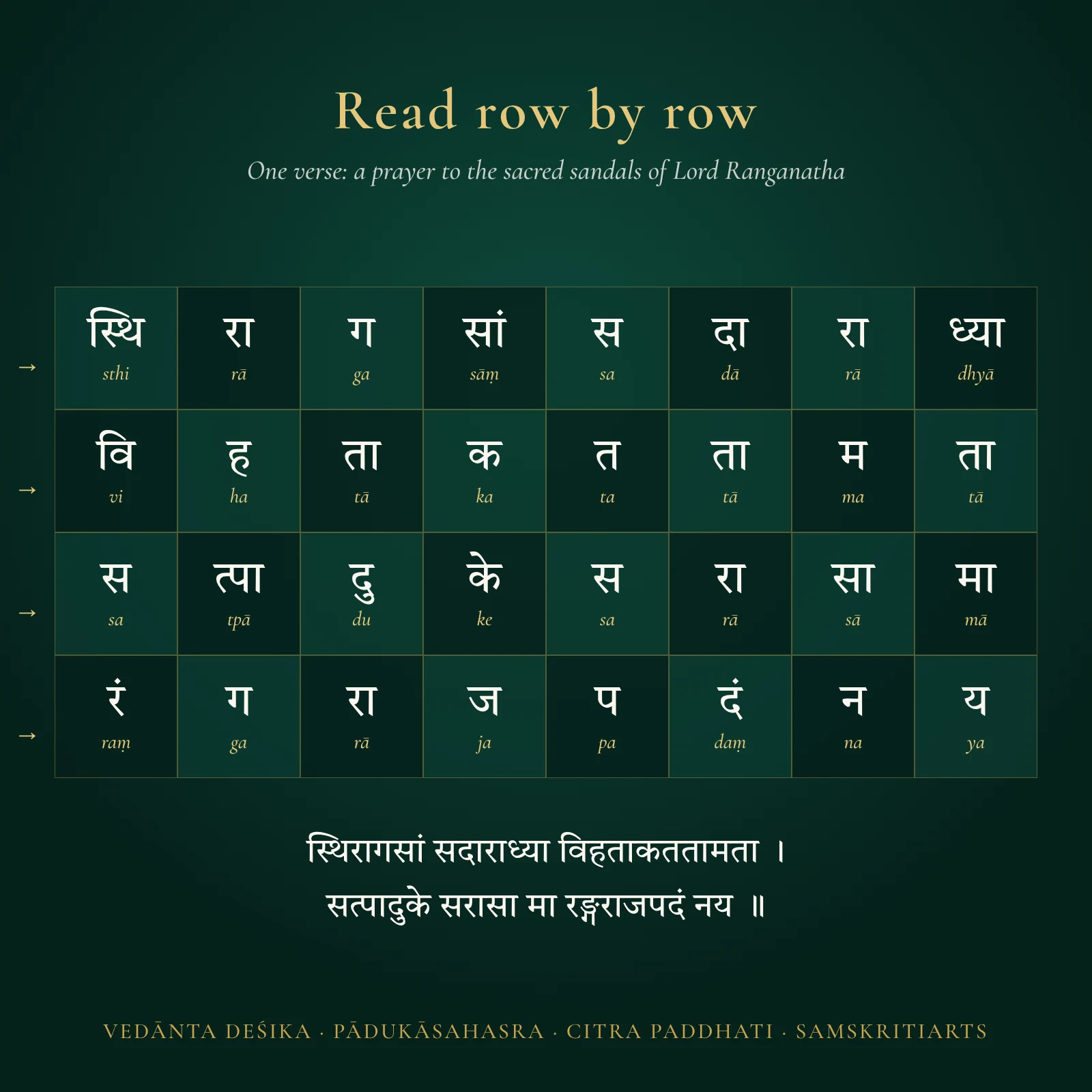
The verse on the board
Take half a chessboard, four rows of eight squares, and write one Sanskrit syllable in each square. Read the board the ordinary way, left to right and row by row, and the thirty-two syllables make a single verse: sthirāgasāṃ sadārādhyā vihatākatatāmatā, satpāduke sarāsā mā raṅgarājapadaṃ naya.
It is a prayer to the pādukās, the sacred sandals, of Lord Ranganatha of Srirangam. In its simplest sense it asks: O good sandals, worshipped always, even by those whose faults run deep, lead me to the feet of Ranganatha. Traditional commentaries take it word by word; the sense given here is a plain summary, not a full translation.
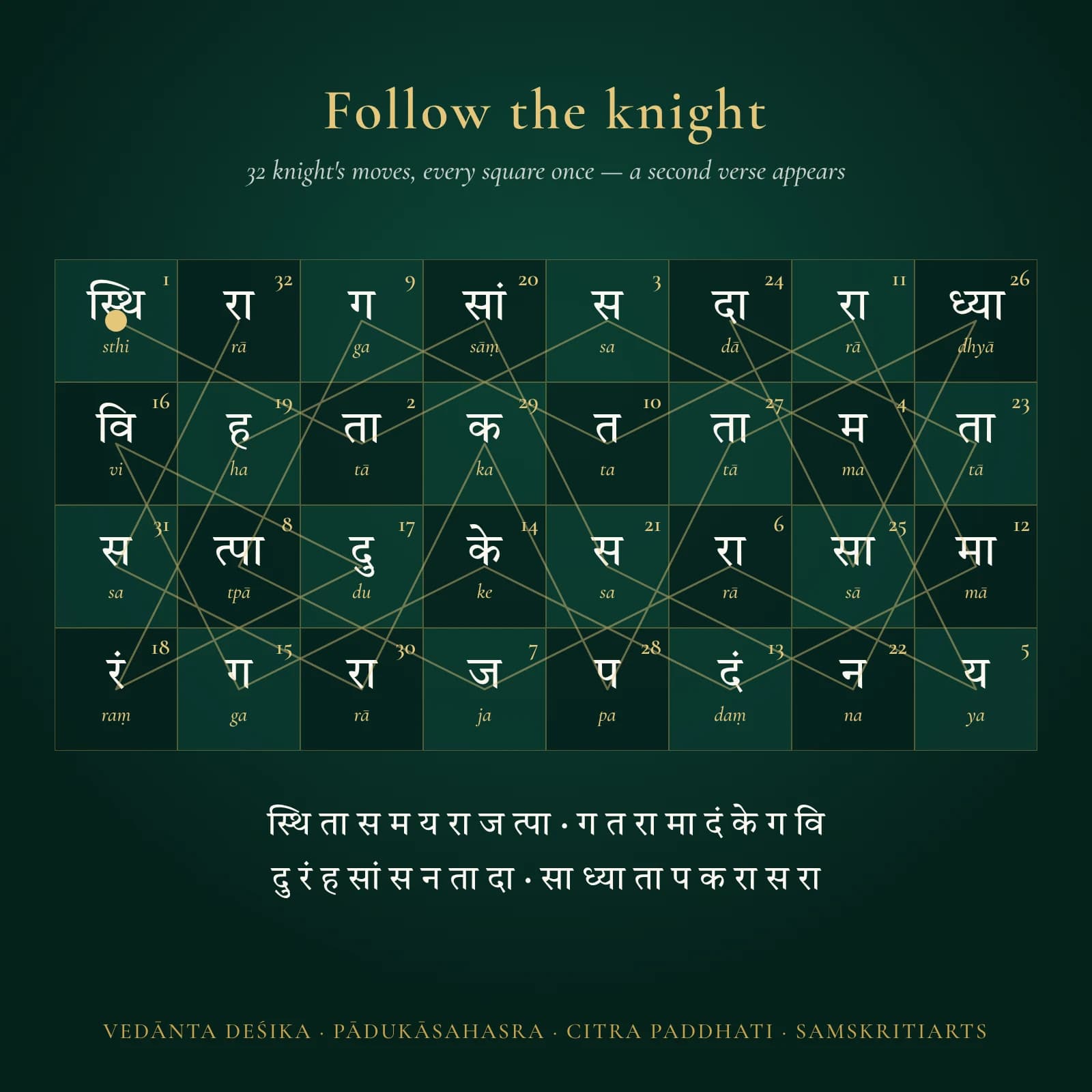
Now place a chess knight on the first square and move it the way a knight moves, two squares one way and one square to the side, so that it lands on every square exactly once. Read the syllables in the order the knight visits them, and a second verse comes out of the same thirty-two syllables: sthitā samaya rājatpā gatarā mādaṃ ke gavi, duraṃhasāṃ sanatādā sādhyā tāpakarā sarā, given here syllable by syllable as the board yields it.
Who made it
The verse comes from the Pādukāsahasra, the 'thousand verses on the sandals', by Vedanta Desika, the Sri Vaishnava poet, philosopher and teacher of the thirteenth and fourteenth centuries, closely associated with Srirangam and Kanchipuram. The work praises the sandals of Ranganatha, which in the Ramayana tradition Bharata placed on the throne of Ayodhya while Rama was in exile.
Sri Vaishnava tradition holds that Desika composed the whole work in a single night. However that is understood, the Pādukāsahasra is arranged in paddhatis, or sections, and one of them, the Citra Paddhati, is given to chitra kavya: verses written under formal constraints, such as palindromes, verses that use only one or two consonants, and verses that take the shape of patterns. The knight's-tour pair belongs there.
Why the knight
Sanskrit poetics has long counted such constructions among the bandhas, or 'bound' forms of verse. Writers on poetics describe a turagapada-bandha, the 'horse-step' form, in which syllables are read along the moves of a chess horse; the Kāvyālaṅkāra of Rudraṭa is often cited as an early discussion. What makes Desika's pair stand out is that the knight visits every square of the half board exactly once and the result is a second verse with its own meaning, not just a rearrangement.
We checked the board with a small program. Starting from the top-left square, there are two complete knight's tours that read out the companion verse; they differ only in the last three moves, between squares that hold the same syllables, so the verse is the same either way.
For reflection today
One reading, and it is only one, is that the puzzle and the prayer are not at odds. The poet used every bit of his craft, down to the moves of a chess piece, and the words still end where devotion ends: at the feet of the Lord. Craft offered with care can itself be a form of worship.
We first came across this verse in a short video by the udbhava channel on YouTube, which lays the board out beautifully; the diagrams here are our own.
Made-to-order printBring this story home →Poster, canvas or framed · from ₹399 · shipped across India#ChitraKavya#VedantaDesika#Padukasahasra#Sanskrit#KnightsTour#Srirangam
Inspired by this story
The art of this chapter
Keep reading, one chapter at a time.
New stories and the art behind them, delivered thoughtfully.