Nine Nights, Ten Divine Wisdoms: Exploring Navaratri Through the Dasha Mahavidyas
Navaratri 2026 | A Journey Through Shakti, Wisdom and Transformation
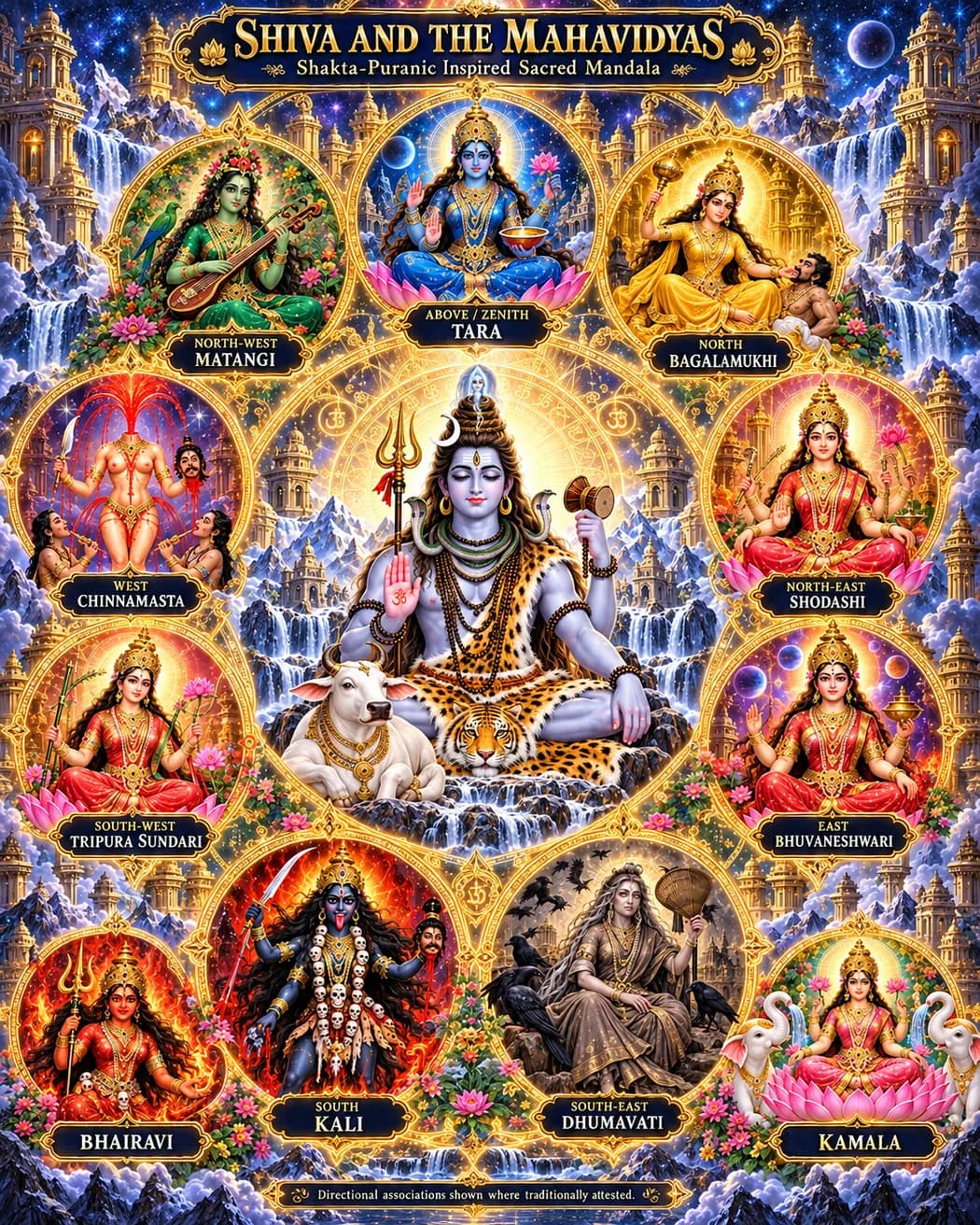
Every year, we celebrate Navaratri (నవరాత్రులు), nine sacred nights dedicated to the Divine Feminine.
We worship Goddess Durga in nine forms, celebrate the victory of good over evil, and welcome Vijayadashami as a symbol of triumph and renewal.
But while exploring Shakta traditions, an interesting question emerges:
If Navaratri celebrates nine forms of Shakti, why does another important tradition speak of ten Mahavidyas? And what can we learn by studying them together?
The answer takes us into the rich philosophical world of Hindu Goddess traditions.
The Navadurga and Dasha Mahavidyas: Two Sacred Traditions
Navadurga (नवदुर्गा) refers to nine revered forms of Durga: Shailaputri, Brahmacharini, Chandraghanta, Kushmanda, Skandamata, Katyayani, Kalaratri, Mahagauri and Siddhidatri.
Their names appear in the Devi Kavacha, traditionally recited alongside the Durga Saptashati.
Dasha Mahavidya (दशमहाविद्या), meaning the Ten Great Wisdoms, is a distinct grouping especially important in Shakta and Tantric traditions.
These ten forms are Kali, Tara, Tripura Sundari (Shodashi), Bhuvaneshwari, Bhairavi, Chinnamasta, Dhumavati, Bagalamukhi, Matangi and Kamala.
Their iconography spans the serene and the fierce, abundance and renunciation, beauty and impermanence.
The two groupings are not interchangeable. No single universally accepted ancient scripture prescribes an exact nine-day correspondence between them.
However, by comparing their symbolism, we can develop a meaningful framework for reflection during Navaratri.
The following associations are interpretive connections based on shared themes—not traditional deity identities or prescribed ritual correspondences.
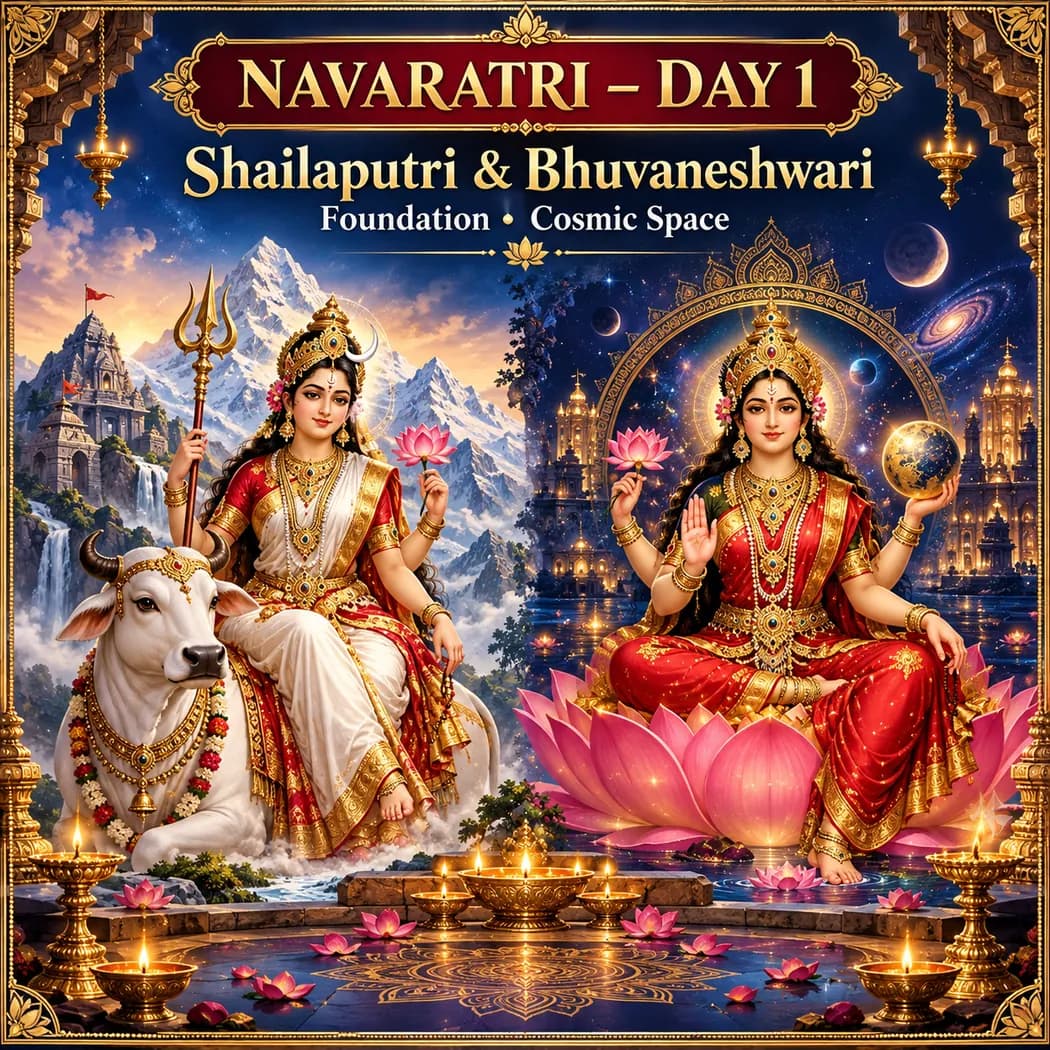
Day 1 — Shailaputri and Bhuvaneshwari
Theme: Foundation and Cosmic Space
Shailaputri, daughter of the mountains, evokes stability, grounding and the beginning of a spiritual journey.
Bhuvaneshwari, whose name signifies the Sovereign of the Worlds, represents the vastness in which existence unfolds.
Together, they invite an interesting reflection: meaningful growth needs both a stable foundation and the space to expand.
Reflection: Before seeking growth, understand the ground on which you stand.
Day 2 — Brahmacharini and Bhairavi
Theme: Discipline and Transformation
Brahmacharini represents tapas, devotion, restraint and perseverance in spiritual practice.
Bhairavi, a fierce Mahavidya, is associated with transformative power and intense spiritual energy.
Their connection lies in the discipline required for transformation. Wisdom is not always acquired through comfort. Sometimes it demands commitment, self-examination and persistence.
Reflection: Discipline can transform intention into lasting inner strength.
Day 3 — Chandraghanta and Bagalamukhi
Theme: Courage and Restraint
Chandraghanta embodies the protective and courageous nature of the Goddess.
Bagalamukhi is traditionally associated with stambhana, the power to arrest or immobilize hostile forces, including harmful speech and action.
One represents courageous response; the other invites reflection on the power of restraint. Together, they highlight the importance of knowing when to act and when to hold back.
Reflection: True strength includes the wisdom to restrain unnecessary conflict.
Day 4 — Kushmanda and Tripura Sundari
Theme: Creation, Beauty and Consciousness
Kushmanda is associated with the creative energy of the universe.
Tripura Sundari, also known as Shodashi, is central to Sri Vidya traditions and is associated with supreme beauty, consciousness and the harmony of existence.
Read together symbolically, they suggest that creation is more than producing something new; it can also be an expression of order, meaning and harmony.
Reflection: Creation becomes more meaningful when guided by awareness and purpose.
Day 5 — Skandamata and Tara
Theme: Compassion and Protection
Skandamata, mother of Skanda, symbolizes maternal protection and nurturing strength.
Tara, whose name is connected with carrying or guiding across, is revered in Shakta traditions as a powerful protective and liberating form of the Goddess.
These forms offer a shared reflection on protection. Care is not weakness. Compassion can be a powerful expression of strength.
Reflection: The ability to nurture and protect is itself a form of courage.
Day 6 — Katyayani and Chinnamasta
Theme: Courage, Sacrifice and Self-Transcendence
Katyayani is a warrior manifestation of Durga, representing determination and the destruction of threatening forces.
Chinnamasta is among the most striking Mahavidyas. Her self-decapitated form has been interpreted through themes of life, death, nourishment, sacrifice and transcendence.
These are very different sacred images, but they can invite reflection on courage beyond self-interest. Katyayani confronts the external adversary. Chinnamasta challenges our assumptions about identity, attachment and existence.
Reflection: Transformation sometimes requires confronting not only external obstacles but also our own attachments.
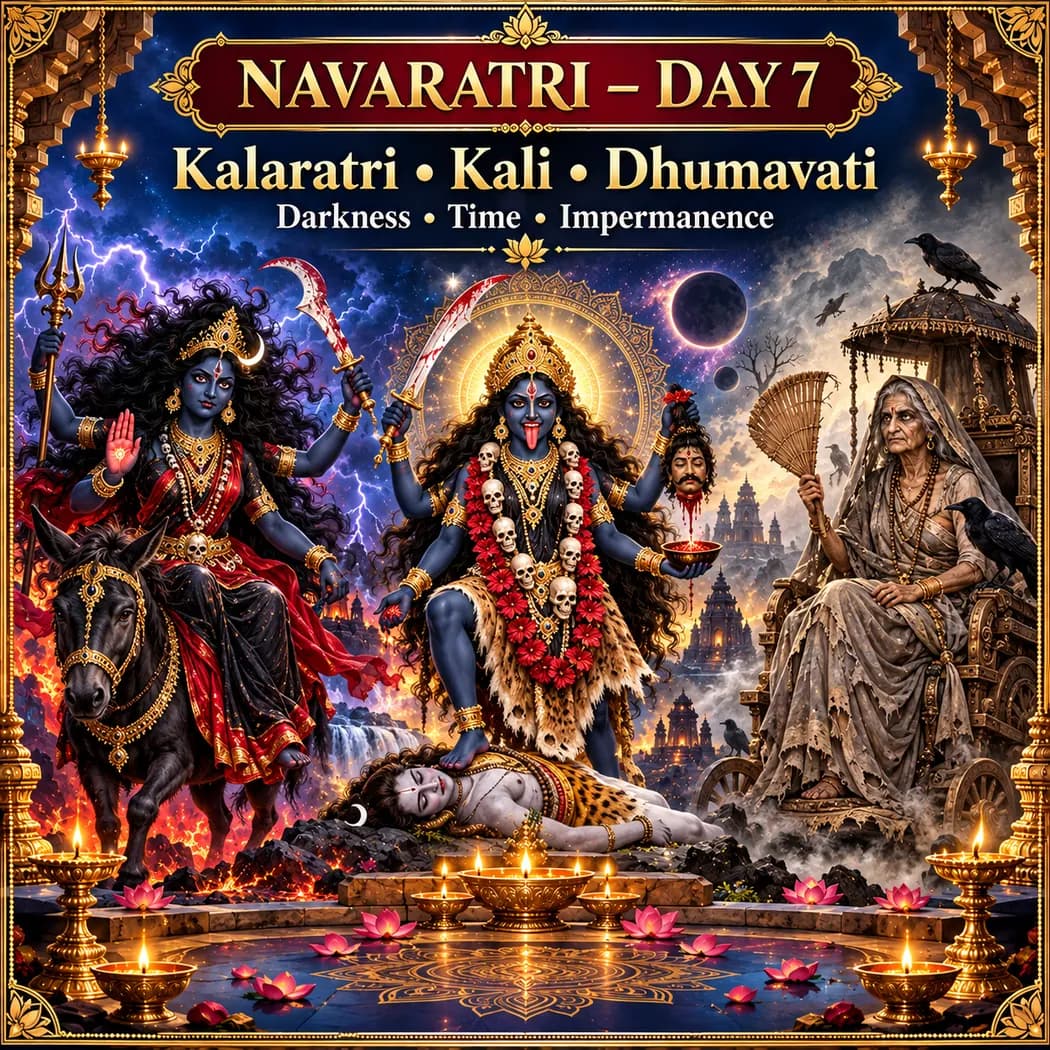
Day 7 — Kalaratri, Kali and Dhumavati
Theme: Time, Darkness and Impermanence
This day offers a particularly interesting opportunity to consider two Mahavidyas alongside one Navadurga form.
Kalaratri embodies the fierce power that dispels fear and destructive forces. Kali is associated with time, transformation, death and liberation. Dhumavati represents difficult realities often avoided in everyday life: loss, deprivation, aging, dissatisfaction and impermanence.
Although their theological meanings are distinct, all three challenge the assumption that wisdom exists only in pleasant experiences.
The presence of Dhumavati is especially important. Her symbolism reminds us that spiritual traditions also make room for suffering, uncertainty and the wisdom of renunciation.
Reflection: Understanding impermanence can deepen our understanding of life.
Day 8 — Mahagauri and Kamala
Theme: Renewal and Auspiciousness
Mahagauri represents purity, serenity and an auspicious, peaceful manifestation of the Goddess.
Kamala, a lotus-seated Mahavidya closely associated with Lakshmi, symbolizes prosperity, fertility, beauty and abundance.
Their symbolic connection invites a broader understanding of well-being. Prosperity is not necessarily limited to material wealth. Renewal, contentment and gratitude can also be forms of abundance.
Reflection: Abundance becomes meaningful when accompanied by inner balance.
Day 9 — Siddhidatri and Matangi
Theme: Knowledge, Expression and Accomplishment
Siddhidatri is revered as the bestower of siddhis, or spiritual accomplishments and powers.
Matangi is associated with speech, music, knowledge, artistic expression and forms of wisdom that challenge conventional social boundaries.
Their connection offers a reflection on how understanding becomes expression. Knowledge has value in itself, but its responsible application and communication allow it to benefit others.
Reflection: Wisdom reaches beyond the individual when it is expressed with awareness and responsibility.
Vijayadashami: The Victory of Shakti
And then comes Vijayadashami — October 20, 2026, in much of India.
Importantly, Vijayadashami is not traditionally designated as a tenth Mahavidya day within the standard Navadurga sequence.
Instead, it can serve as a moment to reflect on the entire journey.
Across nine nights, we have contemplated ten wisdom forms through symbolic associations: strength and compassion, creation and dissolution, discipline and freedom, prosperity and renunciation, expression and silence.
The Mahavidyas remind us that the Divine Feminine cannot be confined to a single emotion, personality or appearance. The fierce and the gentle, the beautiful and the unsettling, all have places in the larger spiritual imagination of Shaktism.
The Deeper Significance: Shiva and Shakti
In certain Shakta narratives, Sati manifests extraordinary forms of divine power before Shiva. These narratives are among the traditional accounts associated with the emergence of the Mahavidyas as a group.
Shiva and Shakti are also understood, in several Hindu philosophical and Tantric traditions, as inseparable aspects of ultimate reality.
Consciousness and dynamic power are not necessarily opposing forces. They can be understood as complementary aspects of existence.
The different manifestations of the Goddess express a rich spectrum of divine wisdom—one that includes creation, protection, transformation, knowledge and liberation.
A Tradition Worth Exploring, Not Oversimplifying
The more we explore Hindu traditions, the more we recognize their depth and diversity.
Navaratri itself is celebrated differently across India. Some communities honor the nine Navadurga forms, while others emphasize Durga, Lakshmi and Saraswati across three sets of days. In different regions, Durga Puja, Bommalakoluvu, Golu, Ayudha Puja and other practices reflect distinct devotional traditions.
The Mahavidyas add another important dimension through Shakta and Tantric philosophy. Studying these traditions together is enriching, provided we respect their differences rather than presenting a symbolic comparison as a scriptural command.
What aspect of wisdom does each form inspire us to contemplate?
May this Navaratri bring clarity in thought, compassion in action, courage in difficulty and wisdom in success.
శుభ శరన్నవరాత్రులు | शुभ नवरात्रि | Happy Navaratri!
Made-to-order printBring this story home →Poster, canvas or framed · from ₹399 · shipped across India#Navaratri2026#DashaMahavidya#Navadurga#Shakti
Inspired by this story
The art of this chapter
Keep reading, one chapter at a time.
New stories and the art behind them, delivered thoughtfully.