The Sri Yantra, Line by Line: Geometry, Worship and Meaning
Nine triangles, two lotuses and a square with four gates: how the Sri Yantra is built, where it comes from, and why drawing it well is so hard.
ಈ ಕಥೆ ಇನ್ನೂ ಕನ್ನಡದಲ್ಲಿ ಲಭ್ಯವಿಲ್ಲ. ಇಂಗ್ಲಿಷ್ ಮೂಲವನ್ನು ತೋರಿಸಲಾಗುತ್ತಿದೆ.
A shape that is also a goddess
Few sacred images are as recognisable as the Sri Yantra: triangles locked into one another, rings of lotus petals, and a square frame with a gate on each side. It hangs in homes and shops, is carved in stone and cast in metal, and is printed on everything from calendars to phone covers.
For the tradition that made it, it is far more than a pattern. This story walks through it line by line: what it shows, where it comes from, why it is so hard to draw well, and how it is kept and honoured.
What the Sri Yantra is
In the Śrīvidyā tradition, the Sri Yantra, also called the Sri Chakra, is the form in which the goddess Lalitā Tripurasundarī is worshipped. It is not a picture of her; it is understood as her body and her abode, to be approached with mantra and ritual.
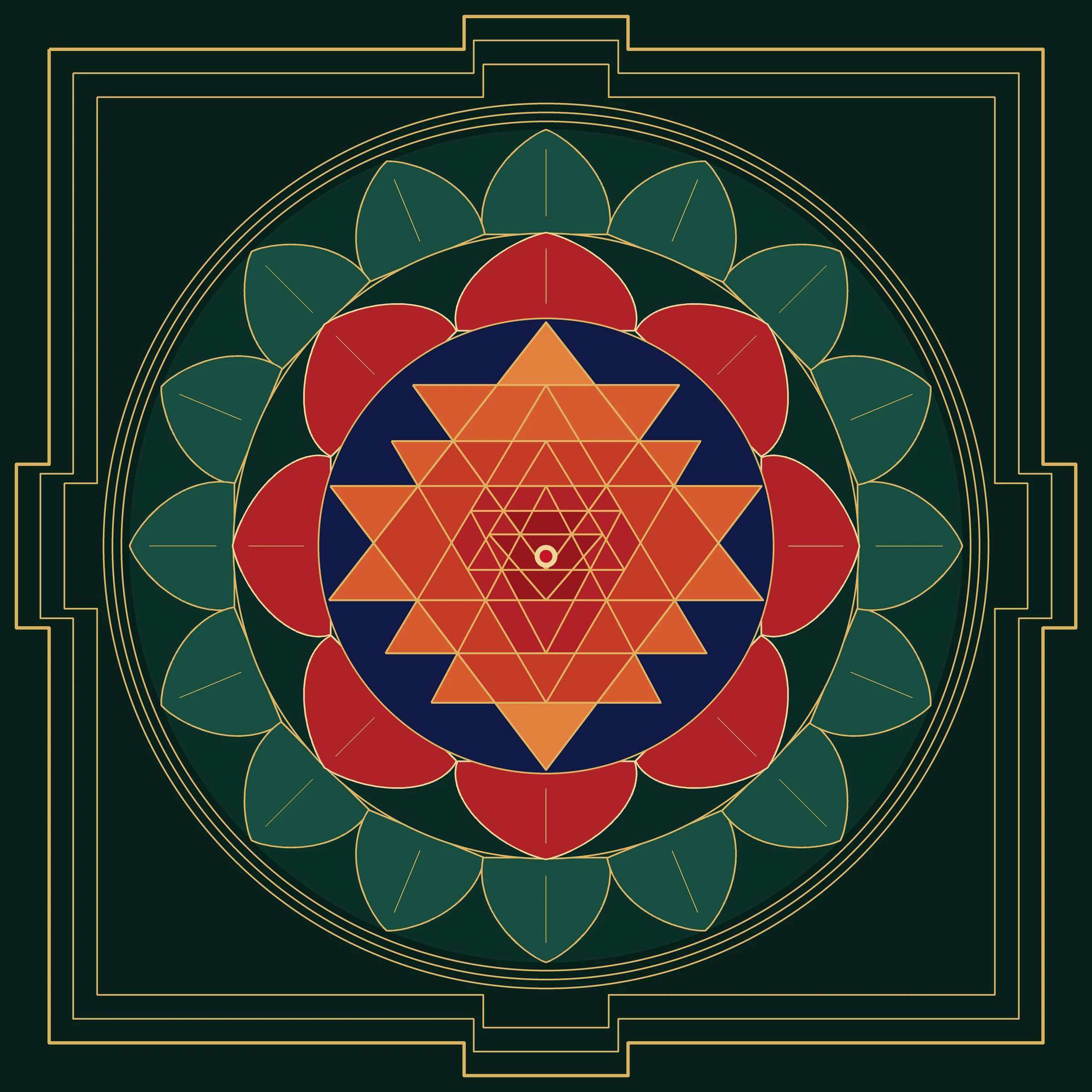
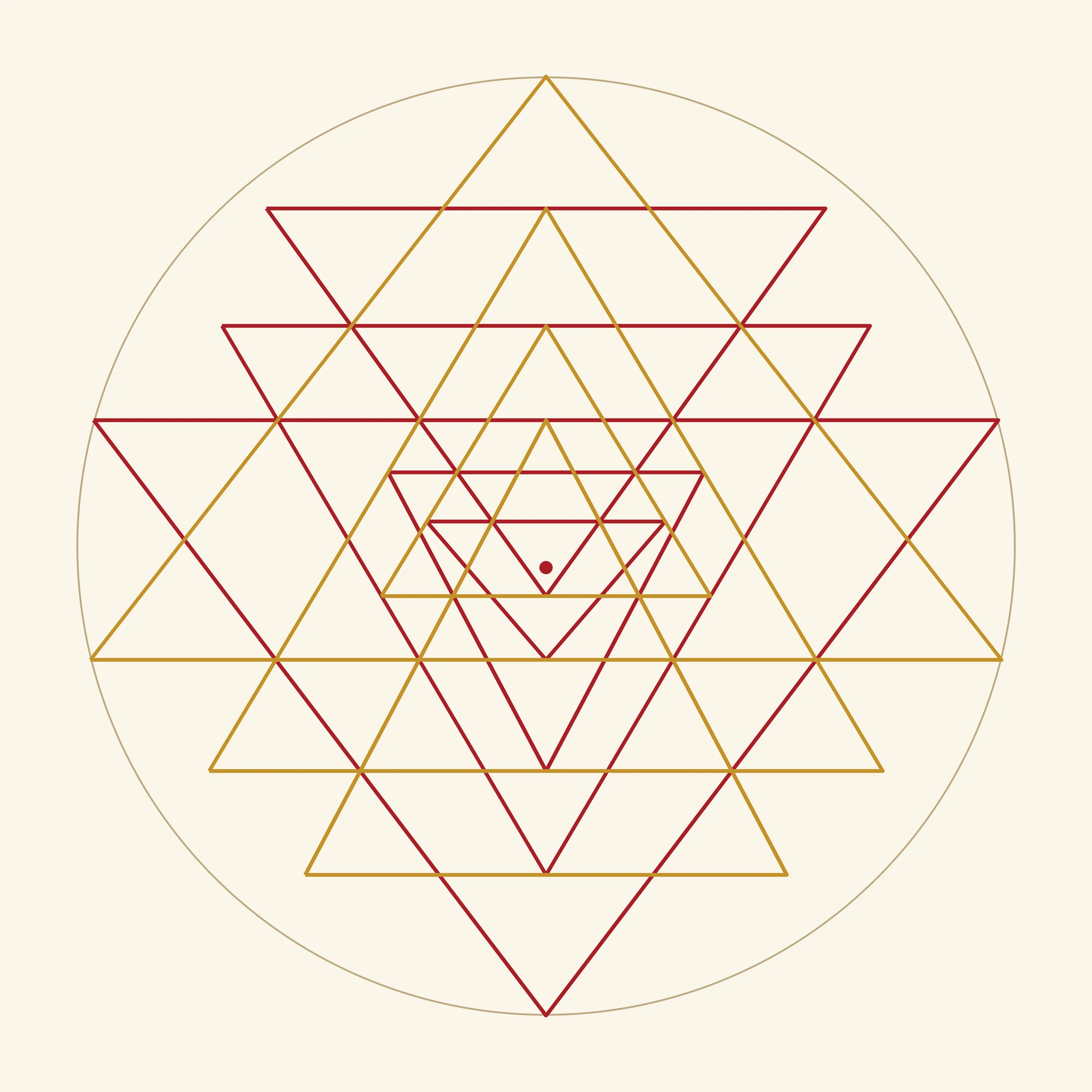
At its heart is the bindu, a single point. Around it, nine triangles interlock: four pointing upward and five pointing downward. Their overlaps form 43 smaller triangles, arranged in rings: one central triangle, then 8, 10, 10 and 14 triangles. Around these sit a lotus of eight petals and a lotus of sixteen petals, circles, and an outer square with a gate on each side, the bhūpura.
The tradition reads the whole figure as nine āvaraṇas, or enclosures, from the outer square inward to the bindu. Worship moves through them in that order, each enclosure with its own deities, so the drawing is also a path: from the outer world to the centre.
Where it comes from
The best-known description is verse 11 of the Saundaryalaharī, the hymn to the Goddess traditionally attributed to Ādi Śaṅkara. It speaks of four 'Śrīkaṇṭha' triangles and five 'Śiva-yuvati' triangles, Śiva and Śakti, together with the lotuses, circles and lines that surround them. That is the source of the common reading of the upward triangles as Śiva and the downward triangles as Śakti.
The yantra's worship is set out in Tantric texts of the Śrīvidyā tradition, among them the Vāmakeśvara Tantra (also known as the Nityāṣoḍaśikārṇava), on which the eighteenth-century scholar Bhāskararāya wrote his commentary, the Setubandha. Śaṅkara tradition holds that Sri Chakras were installed at Kanchi's Kāmākṣī temple and at Sringeri; the yantra is also worshipped in a raised, three-dimensional form called the Meru.
Why it is so hard to draw
In a well-drawn Sri Yantra, many points are meeting points of three lines at once: the corner of one triangle touches the sides of two others exactly. Move one triangle a little and several of these meetings break, so every triangle has to be placed with all the others in mind.
Traditional manuals give step-by-step constructions on a grid, and mathematicians have treated the figure as a problem of solving many conditions together; a 1984 paper by A. P. Kulaichev in the Indian Journal of History of Science is one often-cited study. That is why a carefully drawn yantra looks balanced while a careless copy looks subtly wrong.
The artwork with this story was drawn that way. We placed the nine triangles from a published construction, checked that their lines meet where they should and that the 43 triangles are all there, and then painted the lotuses, circles and gates around them.
What the tradition claims
Popular accounts sometimes say the Sri Yantra gives off measurable energy, or that science has proven its power. We know of no published research that shows this.
The tradition's own claim is different, and it does not depend on a laboratory. For Śrīvidyā the Sri Yantra is a form of the Goddess for worship and a map for meditation, learned with mantra from a teacher. Its value there lies in that practice.
Keeping one at home
Many households keep a Sri Yantra as a sacred image and offer simple worship, a lamp and flowers. Traditionally, full Sri Chakra pūjā is undertaken with initiation (dīkṣā) from a teacher of the tradition, and prāṇa-pratiṣṭhā, the rite that installs a deity in an image, is performed by a priest; a trusted local temple or priest is the right guide.
When you choose one, look at the drawing: nine triangles, the bindu at the centre, lines that meet cleanly, both lotuses and the four gates. Copper, silver, stone and crystal are traditional materials. Our own Sri Yantra artwork is offered as a print for contemplation; it is art, not a consecrated yantra.
For reflection today
The yantra asks you to travel inward: past the gates, through the petals and the rings of triangles, to a single point. One way to take it into an ordinary day, and it is only one, is to ask where your own centre is, and how much of the day is spent at the gates.
Made-to-order printBring this story home →Poster, canvas or framed · from ₹399 · shipped across India#SriYantra#SriChakra#Srividya#SacredGeometry#Lalita#Yantra
Inspired by this story
The art of this chapter
Keep reading, one chapter at a time.
New stories and the art behind them, delivered thoughtfully.